
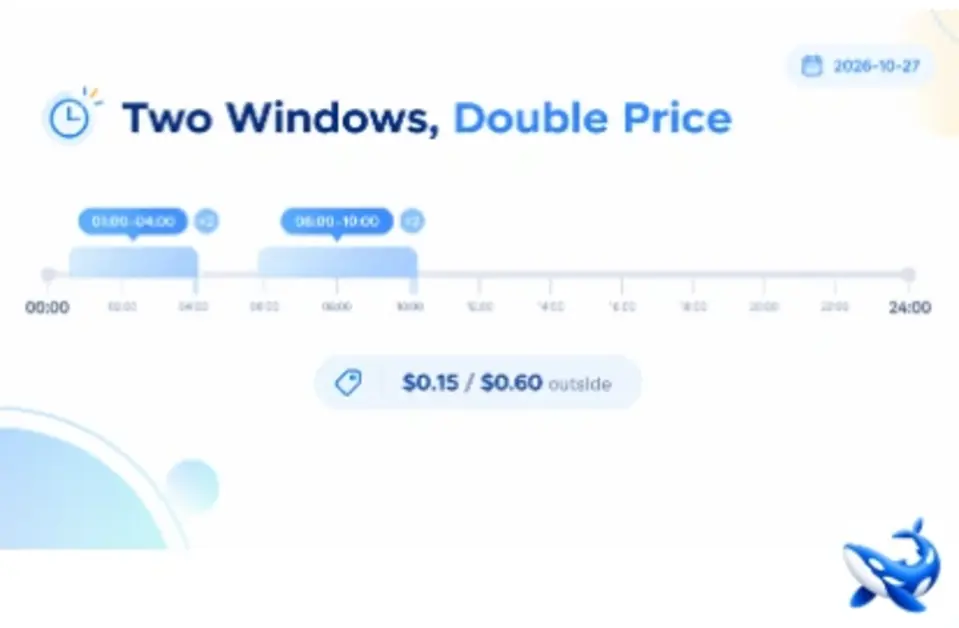
Behind a single OrcaRouter key sits the DeepSeek V4.1 Flash price line: $0.15 in and $0.60 out per million tokens, with cache reads at $0.003 [OURS]. The number that actually reaches your invoice is not that one, because this card carries DeepSeek’s peak schedule: both rates double between 01:00 and 04:00 UTC and again between 06:00 and 10:00 UTC. That is seven hours of every day at twice the price, and it changes the arithmetic for any workload you can schedule.
Seven hours is twenty-nine percent of the clock. If your traffic is flat across the day, your effective input rate is not fifteen cents.
The arithmetic of a flat workload
Spread a million input tokens evenly across twenty-four hours and you pay the base rate for seventeen hours and double for seven:
((17 × $0.15) + (7 × $0.30)) / 24 = ($2.55 + $2.10) / 24 = $0.194 per million
That is a 29% premium over the quoted rate. The output side moves the same way: ((17 × $0.60) + (7 × $1.20)) / 24 = $0.775 per million, against a quoted $0.60.
Blended at a 3:1 input-to-output ratio, the flat-traffic cost is $0.34 per million instead of the $0.2625 the headline implies [OURS]. Still cheap. But a third more than the number most teams budget.
| Base rate | Peak rate (7 h/day) | Flat-traffic effective | |
| Input / M | $0.15 | $0.30 | $0.194 |
| Output / M | $0.60 | $1.20 | $0.775 |
| Blended 3:1 | $0.2625 | $0.525 | $0.340 |
The arithmetic of a scheduled workload
Now move everything you can out of those two windows. Batch jobs, nightly re-indexing, offline evaluation runs, backlog reprocessing — anything where nobody is waiting on the first token.
A workload that runs entirely off-peak pays the base rate with no premium at all. Against the flat-traffic effective rate, that is a 22% saving on blended cost, and against the peak rate it is a 50% saving. Neither requires changing a model, a prompt, or a pipeline — only a cron expression.
There is a catch worth stating: the windows are defined in UTC, and they are not adjacent. 01:00–04:00 and 06:00–10:00 leave a two-hour gap at 04:00–06:00 and a fourteen-hour stretch from 10:00 to midnight. The longest cheap window is fourteen hours, which is enough for a nightly batch but not enough for a job that must run continuously.
The cache line is the bigger lever
At $0.003 per million, a cache read is two percent of the input rate — a fifty-fold discount [OURS]. That is the steepest cache ratio of any card discussed in this series, and on the right workload it dominates everything the peak schedule does.
Take a million input tokens with a ninety percent cache-hit rate:
0.1 × $0.15 + 0.9 × $0.003 = $0.0177 per million
Against $0.15 for the same million fresh tokens, that is 8.5× cheaper. Even inside a peak window, the same calculation gives 0.1 × $0.30 + 0.9 × $0.006 = $0.035 — still four times cheaper than the base rate for fresh input.
The implication is blunt: structuring your prompts so the stable prefix is cacheable does more for your bill than any scheduling decision. Scheduling saves a third; caching saves five-sixths, and the two compose.
Is your workload schedulable?
Four questions decide whether the peak schedule is a cost you control or a cost you absorb.
Does anyone wait on the answer? If a person is watching a cursor, no. If a queue drains overnight, yes.
Can the work be delayed by up to fourteen hours? The longest cheap stretch runs from 10:00 UTC to midnight. Anything with a same-day deadline fits; anything with an hourly one does not.
Is it idempotent? A batch you can re-run after a failure is schedulable. A workflow with side effects halfway through is risky to move, and the risk usually outweighs the saving.
How much is actually at stake? Run the numbers at your own volume. A thousand jobs a day of 100,000 input and 10,000 output tokens costs $0.021 each: $21 a day, or $630 a month at base rates [OURS]. Spread flat across the clock, the same work pays the 29% premium and costs about $813. Moving the whole batch off-peak recovers roughly $183 a month.
A hundred and eighty-three dollars is real money and it is not a reason to rebuild a pipeline. The honest framing is that scheduling is a cheap win when the architecture already allows it — nightly jobs, offline evaluation, reprocessing — and a bad trade when it forces a delayed product.
There is a second-order effect worth mentioning. Schedulable work is usually bulk work, and bulk work is usually read-heavy: the 100,000-to-10,000 shape above is ten to one input. That makes the input rate the dominant term, which makes the peak multiple on input the number to attack first. Output-heavy batch jobs see a smaller absolute saving from the same schedule change because there is less input to move.
What you get for the rate
Price is only half a purchasing decision; the other half is what the card does with the tokens.
The envelope is a 1,048,576-token context with a 393,216-token output ceiling, text and image input, thinking and non-thinking modes with selectable reasoning effort, native tool calling and structured JSON [OURS]. At these rates that envelope is the product: a million-token read costs fifteen cents, and a maximum-length answer costs $0.63 — which, for a three-hundred-and-ninety-thousand-token artifact, is not a meaningful budget item.
Serving numbers over seven days: p50 first token 1,453 ms, p95 6,169 ms, output throughput 199.2 tokens per second, error rate 0.0089% [OURS]. That throughput is the fastest in this batch, and it changes what the price buys: a long answer arrives at roughly two hundred tokens a second, so the ceiling is reachable in about thirty-three minutes rather than hours.
Independent evaluation puts the card at 45.1 on the Artificial Analysis Intelligence Index, 86.7th percentile, with 43.3 on Humanity’s Last Exam, 82.67 on long-context recall and 33.84 on Terminal-Bench v4.0 [INDEPENDENT].
Where the price sits against the alternatives
Within our own catalogue, the two nearest cards are the MiniMax M3.1 Flash at the identical $0.15 / $0.60 and the abliterated OrcaCyber Flash 1.0 at $0.80 / $1.60.
At equal headline rates, the tiebreakers are the output ceiling (393,216 here versus 524,288 on MiniMax) and the cache ratio (two percent here versus ten percent there). On cache-heavy work the DeepSeek card wins the arithmetic by a wide margin; on a single very long answer the MiniMax ceiling is 33% higher.
The takeaway
Fifteen cents is the off-peak rate. A flat workload pays about nineteen and a half cents of input and seventy-seven and a half cents of output, which is a 29% premium most teams do not budget for. Scheduling batch work outside 01:00–04:00 and 06:00–10:00 UTC recovers most of it; making your prefix cacheable recovers far more.
Price the schedule and the cache before you price the model.
Sourcing note: all rates, peak windows, context and ceiling figures are from the OrcaRouter model page and catalogue, checked 2026-10-27 [OURS]. Effective rates are arithmetic on those published rates and assume the traffic distribution stated in each paragraph. Latency, throughput and error rate are OrcaRouter production telemetry for the seven days ending 2026-10-26 [OURS]. The intelligence figure is Artificial Analysis’s published index [INDEPENDENT]. For more information, click here.